On this page
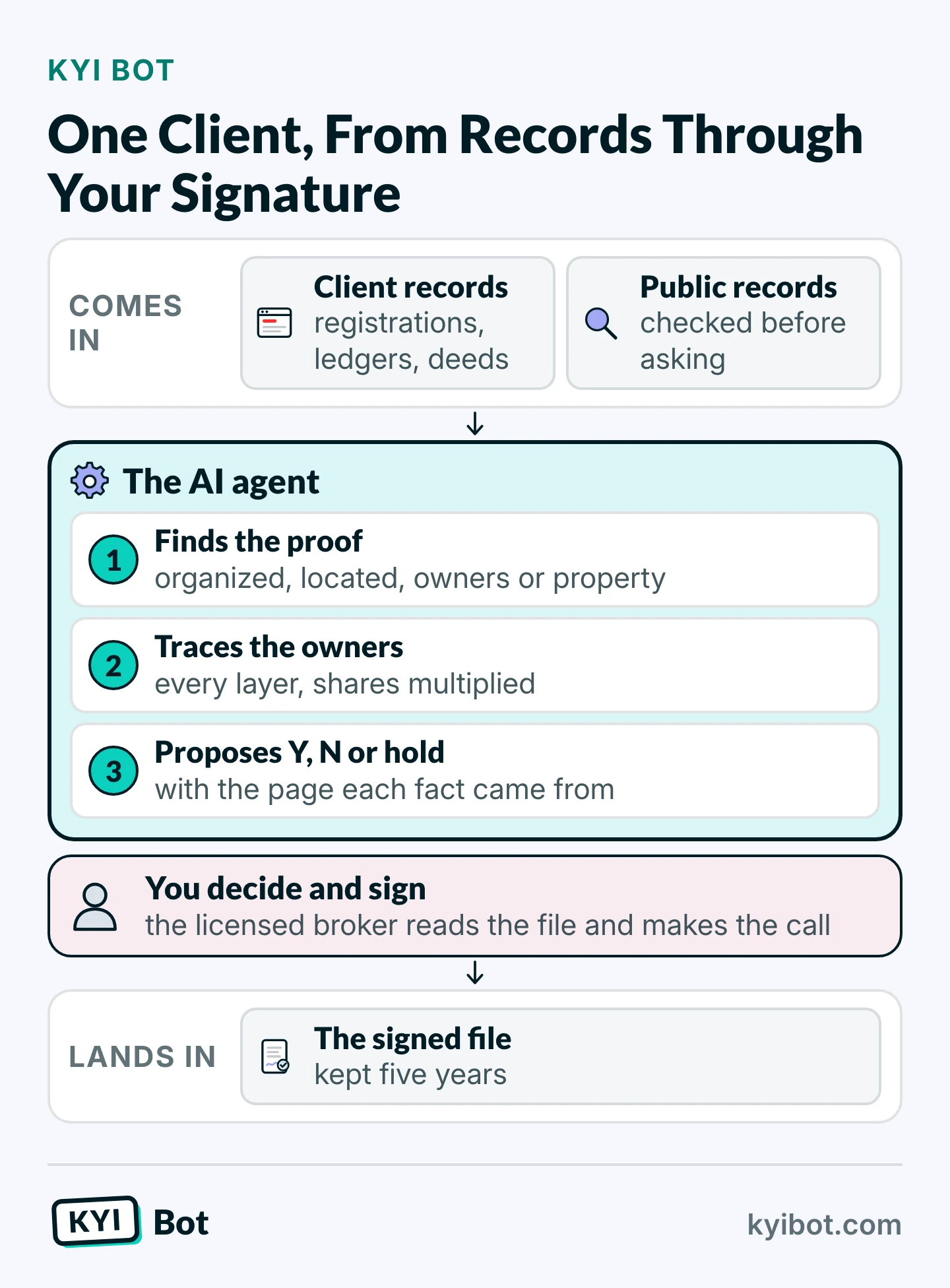
You verify a client in four checks, in this order: the power of attorney, then whether it is organized under US law, then whether it is located in the United States, then its owners or its property.
Each check has a record that proves it. You finish with Y, N or hold, the licensed broker signs, and you keep the file for five years.1
At KYI Bot, we help customs brokerages verify every client before its first entry, by finding the proof and tracing the owners, so the licensed broker can decide and sign.
The power of attorney
Before any customs business, and ask for the records in the same request.
Organized
Under US law: the state's records.
Located
In the United States: a judgment on CBP's factors.
Owners or property
51% US beneficial owners with control, or directly owned unencumbered real property.
The rule asks you to request and review a client's records before you file a declaration for it, and that includes clients you already file for: the check comes before the next declaration from 5 January 2027, or by 6 May 2027 if CBP grants your brokerage delayed compliance for the verification. The new data fields are required from 5 January either way.13
Start at the Power of Attorney
You need a valid power of attorney before you do any customs business for a client, including when you act as its importer of record.1 Ask for the verification records in the same request.
A person is the short case: a US citizen or permanent resident qualifies, and CBP's reference guide lists the records to file, such as a US passport or a permanent resident card.12 Everything below is for companies.
Check It Is Organized Under US Law
The company must be organized under the laws of the United States.1 CBP's reference guide points to Secretary of State records and the state business registration.2 It is usually the quickest gate to close.
Weigh Whether It Is Located Here
This gate is a judgment. CBP takes into account the size and scale of the company's operations and whether it is an instrumentality of a foreign manufacturer without a substantial presence here.1
The rule lists criteria CBP may consider, at its discretion and not limited to these:1
- whether the principal place of business is in the United States;
- a physical presence where substantial business is done here: paying employees, generating revenue, operating retail locations;
- sufficient unencumbered physical domestic assets;
- direct ownership of a significant amount of unencumbered US real property;
- gross sales that generally exceed the cost of goods sold, in a business structured to make its own profit;
- whether it is sufficiently capitalized.
The rule does not say how much weight each one carries, and CBP decides case by case. Write down which ones you relied on and the document behind each.
Then Owners, or Property
A company passes on one of two routes, and either must hold at all times.1
Owners. At least 51% of its beneficial owners must be US citizens or permanent residents and have control of the company. A beneficial owner is a person who exercises substantial control, or owns or controls at least 25%, through every layer of companies in between.1 The rule leaves some people out, such as a nominee acting for someone else.
Trace each owner that is a company up to the people, multiply the shares along each branch and add the branches that reach the same person.
Then count the US share two ways: by people and by ownership. The regulation's text counts beneficial owners; CBP's reference guide describes the test as “at least 51% owned/controlled by U.S.” citizens or permanent residents.12
When the two counts disagree, the sources do not say which one controls, so neither count alone is a safe basis for a Y. Record both counts and your reasoning, and hold, or put the question to CBP, before you declare. The decision stays with the licensed broker.
When the two counts disagree, record both and hold before you declare.
Property. Instead, the company can directly own a significant amount of unencumbered US real property. CBP's FAQ puts it at the greater of 100% of the prior year's entered value or $20 million.3
Only the value net of mortgages and liens counts. Take the deeds and titles from the client, and the mortgages and liens from the county record, not from the client alone.
The tracing is where the hours go. The calculator below prices them on a book with layered owners.
KYI Bot ROI Calculator
What Does Verifying Every Client by Hand Cost?
A book of 323 clients with owners through other companies, at our 8 hour estimate.
CBP counts 323 US importers for the average broker.
What the hours cover
- First verification4 h
- Chasing missing papers2 h
- Re-checks when owners or loans change1 h
- Keeping the five-year file0.5 h
- Preparing it when CBP asks0.5 h
The first check uses published figures for a manual background check: 0.5 to 4 hours, with one study planning on 1.5. The rest is our estimate.
With KYI Bot, your team still answers client questions and anything flagged: we count half an hour per client for that.
Signing takes the same time either way, so it is left out. Months to cover the fee assume the work spreads evenly over the year.
Sources: CBP's rule (91 FR 69977) for $38.88 an hour and 323 clients per broker; a broker's public comment to CBP for 15 hours. KYI Bot at full price, before the early sign-up discount.
Estimated saving, first year
$64,117
KYI Bot for this book: $30,070 a year, about $93 a client.
- Saved per client
- $199
- Hours saved
- 2,423
- Months to cover the fee
- 3.8
8 h is our estimate for owners through other companies; 15 h is one broker's count to CBP. $38.88 is CBP's own figure for an hour of this work.
Decide, Sign and Keep the File
You decide Y, N or hold, and the licensed broker signs. Missing evidence is a hold, never a pass.
If questions stay unresolved after you ask for more, CBP's reference guide says brokers should decline to verify the client as a US importer of record, or decline the business.2 An N means a foreign importer of record: its consumption entries can then go only through a CTPAT-validated broker, unless it is validated itself and has the right to make entry.1
Keep the verification records for five years from the date of the verification; the power of attorney follows its own retention rule. If CBP verifies the declaration, the decision on whether the client qualifies is made by the appropriate Center Director, and your file is what you hand over.1
 Piotr BabelPartner @ Qvery
Owners are where a file goes wrong. A holding company two layers up, a 20% stake that adds up with another one on a different branch, a manager who owns nothing but runs the place: each needs its own record, and the answer only counts when every branch ends in a person. Write the arithmetic into the file, so the next person can check it without redoing it.
One Client, Worked Through
Pellworth Outdoor Supply LLC (a fictional client) is an Ohio company. Its operating agreement names two members: Corinne Hadley, 60%, the managing member, and Marcus Oyelaran, 40%. Both hold US passports.
| Gate | Record | Result |
|---|---|---|
| Organized | Ohio registration | Pass |
| Located | Lease, payroll, bank statements | Pass, your call |
| Owners | Operating agreement, two US passports | By people 2 of 2; by share 100%; control: the managing member |
| Decision | Signed and dated, review date set | Y |
Most files are not this clean. A procedure written once, with the same steps on every client, is what keeps the hard ones consistent.
When a file is not clean, the hold and the request you send are the next step, not a guess.
Run the next file in this order, and keep the arithmetic in it.
 Vlad ShvetsPartner @ Qvery
Brokers asked us one thing again and again on our first calls: show me the page each answer came from. So every fact in the file points at its document, and you sign only when you agree with what you see. The reading and the tracing can be done for you; the call on each client stays where the rule puts it, with the licensed broker.
Frequently asked questions
Can I rely on the client's statement?
No. The rule asks you to request and review the client's records before you file a declaration for it. A signed statement from the client is useful on file, but it does not replace the records.
In what order should I check?
Power of attorney, organized, located, then owners or property. The first two are quick; the last is where the hours go.
What records prove a company is organized here?
CBP's reference guide points to Secretary of State records and the state business registration. They are usually the quickest records to get.
Does a US address make a company located here?
Not on its own. CBP weighs the size and scale of the operations and factors such as the principal place of business, staff, revenue and assets here.
Who counts as a beneficial owner?
A person who exercises substantial control over the company, or owns or controls at least 25% of it, through any layers of companies. A nominee acting for someone else is left out; look through to the person behind.
What if a client will not send its records?
It stays on hold. Date each request so the file shows you asked. If questions stay unresolved, CBP's reference guide says to decline to verify or decline the business.
What if the two 51% counts disagree?
The sources do not say which count controls, so neither alone is a safe basis for a Y. Record both and your reasoning, hold or put the question to CBP, and let the licensed broker decide.
Can property from another company count?
No. The property route needs US real property the client owns directly, at all times, and only its value net of mortgages and liens counts.
Who decides if CBP disagrees?
The appropriate Center Director decides whether the client qualifies. Your file is what shows how you reached your answer.
Do I check again later?
Yes. CBP's reference guide expects verification on an ongoing basis for the duration of the broker and importer relationship, and its FAQ says how often depends on the circumstances: a recently established company may need it more often than a large publicly traded one.
How long do I keep the file?
The verification records stay five years from the date of the verification. The power of attorney follows its own retention rule.
Sources
- Federal Register: 91 FR 69977, interim final rule on importer of record verification (2026)
- U.S. Customs and Border Protection: Importer of Record Status Declaration Requirements: reference guide (2026)
- U.S. Customs and Border Protection: Strengthening Customs Enforcement: frequently asked questions (2026)