On this page
Software can do the reading, the tracing, the arithmetic and the chasing: pull the state and county records, read each document with the page cited, trace the owners and run the 51% test, net the property against its liens, and ask the client for what is missing.
The licensed broker keeps the calls CBP's own documents leave to judgment, and signs. If CBP later disagrees about a client, a CBP Center Director decides.1
At KYI Bot, we help customs brokerages verify clients in less time, by doing the reading and the arithmetic and leaving the decision and the signature with the licensed broker.
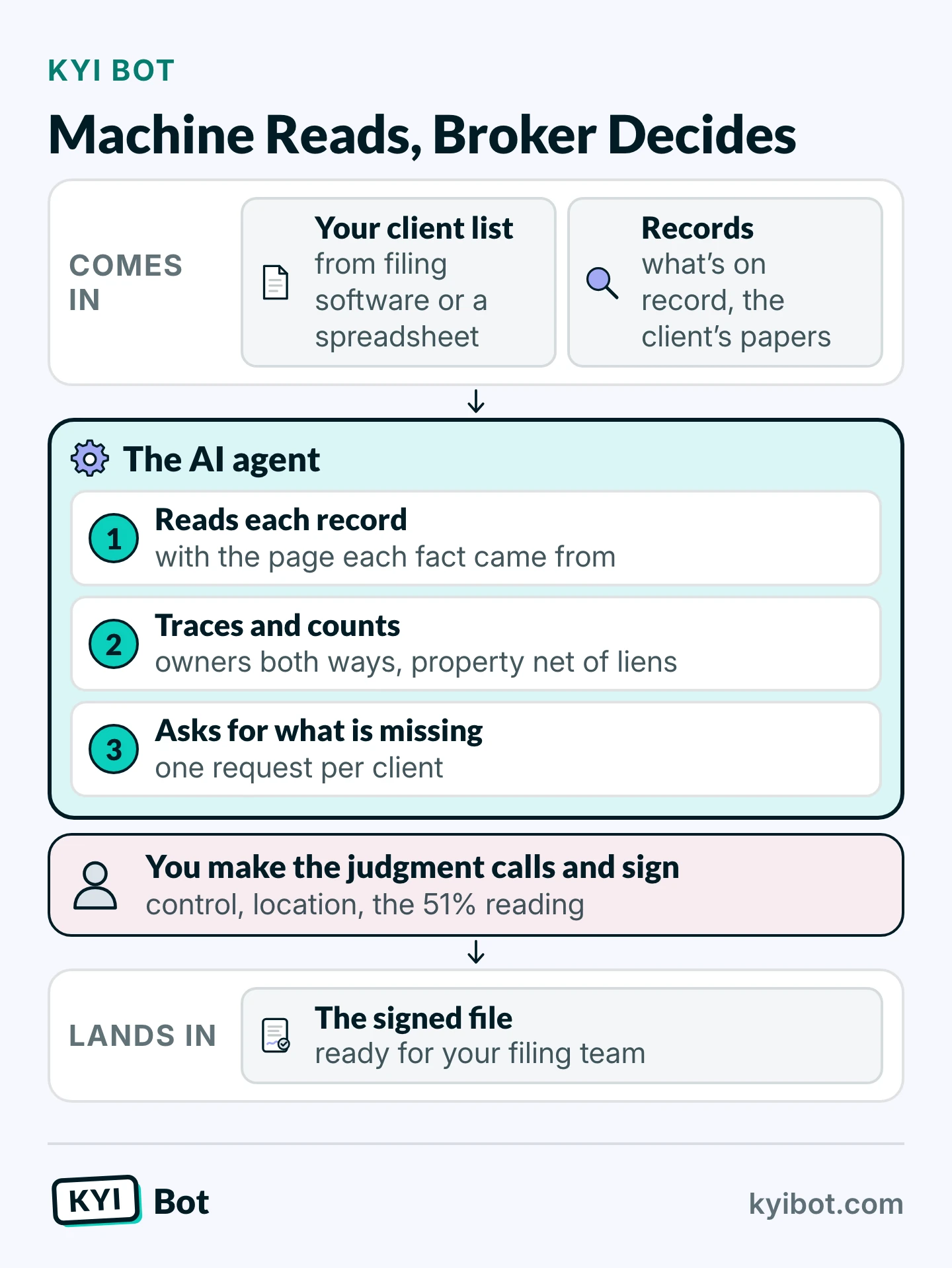
What Software Can Do
Each client's records must be requested and reviewed before you declare it.1 Much of the work in that sentence is reading and arithmetic.
| Task | What the software does | What you check |
|---|---|---|
| State and county records | Pulls the registration and the recorded liens | That the record is the client's |
| The client's documents | Reads them, with the page each fact came from | The pages behind anything that decides the answer |
| Owners | Traces each branch to the people, keeps those with 25% or more, runs both 51% counts | Control, the exclusions, and where the two counts disagree |
| Property | Nets the value against the liens, compares the threshold | The valuation and its date |
| Missing records | Lists them and drafts one request per client | That the request goes out |
What Stays With the Licensed Broker
CBP's documents leave these to judgment, and they stay with the licensed broker whatever tool reads the records:
Substantial control
The preamble says a senior officer, someone who can appoint or remove officers, or an important decision-maker can exercise it. Whether a given person does is read from the documents.1
Location
CBP considers its criteria in its discretion and to the extent they are relevant. How much each weighs is a call.1
Assets bought to qualify
CBP's guide warns about assets recently obtained just to meet the test.2
Side agreements
The guide lists confirmation that there are no undisclosed side agreements among the ownership evidence. Whether to accept it is your call.2
 Piotr BabelPartner @ Qvery
We built KYI Bot to stop exactly where judgment starts. It reads, it traces, it does the arithmetic, and it shows the page behind every fact. When a file needs a call on control, on location or on the 51% reading, it puts both sides in front of the licensed broker and waits. That boundary is the product, not a limitation of it.
Who Decides a Dispute
When CBP verifies a declaration, the decision on whether the client qualifies is made by the appropriate Center Director.1 Software does not change that, and neither does your signature. What you hand over is the file; the rule says the verification records stay five years, counted from each verification.1
The machine reads and counts; the licensed broker decides and signs.
Where the Client's Data Goes
Ask any vendor where the data is stored, whether it is encrypted, whether it is used to train AI models, who can open a file, how long it is kept, and how you hand a file to CBP.
KYI Bot's answers: in the United States, encrypted, never used to train AI models, kept for the five years the rule requires for verification records, with ID numbers masked on screen, opened only by the people you invite, and exported in one click when CBP asks.
How to Start
Export your client list from your filing software, CRM or a spreadsheet, and work the clients with the soonest entries first. The calculator below prices the hours your team spends on the reading and the arithmetic today.
KYI Bot ROI Calculator
What Would Automating the Checks Save You?
CBP's average book of 323 importers, at $60 an hour.
CBP counts 323 US importers for the average broker.
What the hours cover
- First verification1.5 h
- Chasing missing papers1 h
- Re-checks when owners or loans change0.5 h
- Keeping the five-year file0.5 h
- Preparing it when CBP asks0.5 h
The first check uses published figures for a manual background check: 0.5 to 4 hours, with one study planning on 1.5. The rest is our estimate.
With KYI Bot, your team still answers client questions and anything flagged: we count half an hour per client for that.
Signing takes the same time either way, so it is left out. Months to cover the fee assume the work spreads evenly over the year.
Sources: CBP's rule (91 FR 69977) for $38.88 an hour and 323 clients per broker; a broker's public comment to CBP for 15 hours. KYI Bot at full price, before the early sign-up discount.
Estimated saving, first year
$37,760
KYI Bot for this book: $30,070 a year, about $93 a client.
- Saved per client
- $117
- Hours saved
- 1,131
- Months to cover the fee
- 5.3
4 h and 8 h are our estimates; 15 h is one broker's own count to CBP. $38.88 is CBP's figure; one broker says this staff costs at least double.
A written procedure says where the machine's work ends and yours begins, the same way on every client.
Then test any tool against that procedure, page by page.
Bring the hardest file you have.
 Vlad ShvetsPartner @ Qvery
Most brokers I talk to do not want a robot that decides for them, and they are right. They want the reading and the chasing behind each hard file to stop eating their week, so the time they spend goes on the review. The judgment was always theirs. Retyping a member register into a spreadsheet was never a good use of a licensed broker's time.
Frequently asked questions
Can software sign the decision?
No. KYI Bot suggests an answer with its reason, and nothing is declared until the licensed broker signs.
Which calls stay with the broker?
Substantial control, how the location criteria weigh, assets obtained to qualify, side agreements, how often to look again, and the 51% reading when the counts disagree.
Does it work out the ownership math?
Yes. It traces each branch to the people, adds up stakes across branches, keeps those with 25% or more and runs both 51% counts. Control, the exclusions and the call when the counts disagree stay with you.
Can it read foreign owners?
Where the register is public, such as the UK and Canada's federal companies. In India, Hong Kong and Singapore it reads what is public and asks the client for the rest. In the EU, China and Mexico it asks the client and flags the file.
Where is the data kept?
In the United States, encrypted, never used to train AI models, and kept for the five years the rule requires for verification records.
Who can open a client file?
Only the people you invite. ID and account numbers are masked on screen.
How do I hand a file to CBP?
Export the whole file in one click.
Does it replace my filing software?
No. It starts from a client list you export from your filing software, CRM or a spreadsheet, and each signed answer is ready for your team when they file.
Who decides if CBP disagrees?
A CBP Center Director, when CBP verifies a declaration. The signed file is your account of the reasoning.
Does automation change what CBP expects of me?
No. Requesting and reviewing the records, declaring status on every entry, and keeping verification records for five years, counted from each check, stay your duties whatever tool does the reading.
What happens when a record is missing?
It is a hold, never a pass, and the client gets one short request for what is missing, with a link to upload it.
How do we start?
Export your client list and begin with the clients whose next entries are soonest. There is no setup fee and no minimum.
Sources
- Federal Register: 91 FR 69977, interim final rule on importer of record verification (2026)
- U.S. Customs and Border Protection: Importer of Record Status Declaration Requirements: reference guide (2026)
- U.S. Customs and Border Protection: Strengthening Customs Enforcement: frequently asked questions (2026)